Accelerating Research with AI Integration
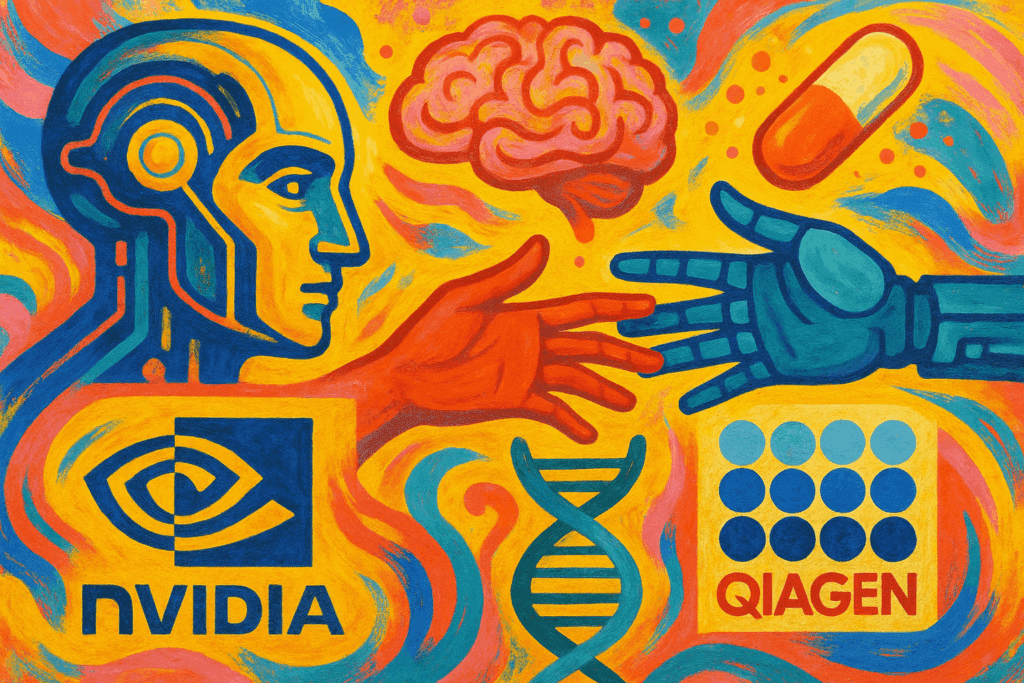
QIAGEN and NVIDIA announced a strategic partnership to bring QIAGEN Digital Insights bioinformatics into NVIDIA’s BioNeMo platform. The goal is to combine QIAGEN’s domain-specific tools and curated biological data with NVIDIA’s accelerated computing and large-scale generative models to speed hypothesis generation across drug discovery workflows.
Leveraging Advanced AI and Data
Central to the collaboration are NVIDIA’s BioNeMo models and graph-based AI techniques, paired with QIAGEN’s multi-omics pipelines and knowledge resources. Graph-based AI and biomedical knowledge graphs let systems represent genes, proteins, pathways and clinically annotated biomarkers as interconnected entities. Coupled with BioNeMo’s capacity to train and deploy large models on accelerated infrastructure, researchers can query complex relationships across datasets at scale.
Real-World Applications and Impact
For R&D teams, the combined stack targets several high-value use cases: target identification by surfacing mechanistic links between disease biology and druggable nodes; biomarker discovery through pattern recognition across proteomics, transcriptomics and clinical annotations; drug repurposing by locating shared pathway signatures between indications. The integrated platform also supports multi-omics integration, enabling more robust hypotheses and prioritization of experiments before costly wet-lab validation.
The Future of Collaborative Discovery
QIAGEN and NVIDIA say the offering will be available to research and biopharma customers through BioNeMo, with initial integrations focused on data interoperability and model access. Beyond immediate tools, the partnership signals a broader shift toward tightly coupled software, curated domain data and scalable AI compute as standard infrastructure for discovery. For investors and R&D leaders, that shift could shorten timelines from target nomination to lead selection and improve the signal-to-noise ratio of preclinical programs.
As AI models and biomedical graphs mature, expect more collaborations that fuse domain expertise with high-performance AI to translate complex biology into testable drug hypotheses.