
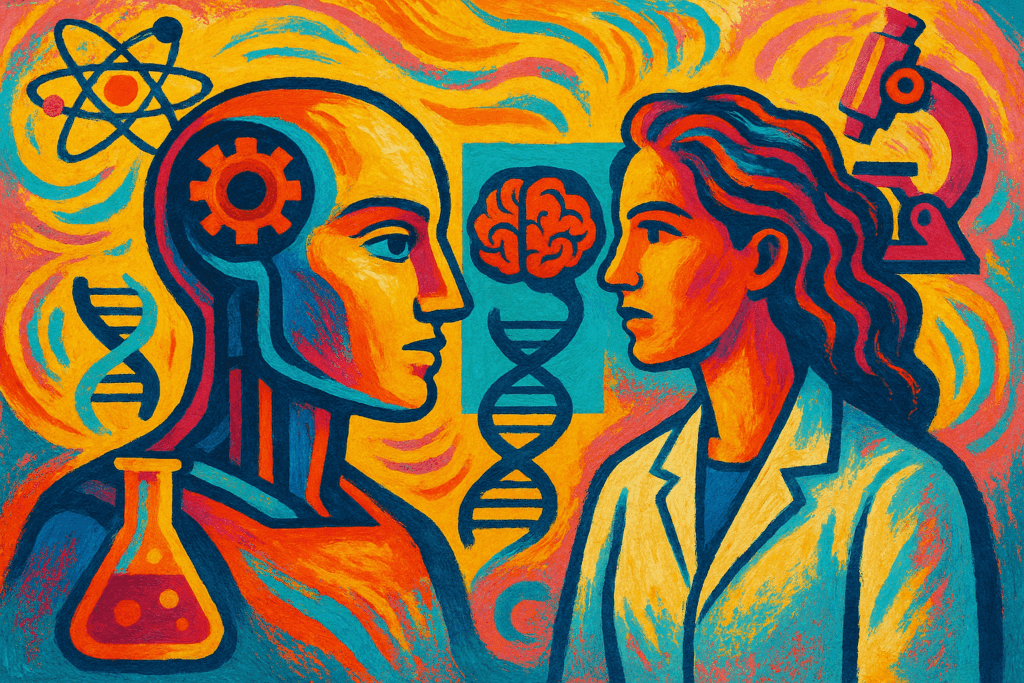
Agentic AI: Powering “In Silico” Team Science in Biomedical Breakthroughs
What is Agentic AI in Biomedical Research?
Agentic AI refers to systems of computational agents that act with autonomy, plan, test hypotheses and coordinate to solve complex problems. In a biomedical setting these agents behave like specialized experts: some mine literature, others design experiments, and others analyze results. “In silico team science” describes virtual collaborations among these agents and human researchers to run iterative research cycles entirely in software before moving to the bench.
Transforming Key Research Areas
Agentic AI is changing where time and effort are spent. In drug discovery, multi-agent pipelines can propose targets, run virtual screens, predict ADMET properties and prioritize candidates for synthesis, compressing lead identification from months to weeks. For data analysis, agents standardize and integrate heterogeneous datasets, spot hidden correlations and generate interpretable hypotheses for follow-up. In biomarker identification, in silico teams combine multi-omics, clinical and imaging data to rank robust candidates and suggest validation pathways.
Common labor-intensive tasks that are accelerated include literature synthesis, protocol design, dataset curation and iterative model-driven experiment planning. By automating routine decisions and triage, human scientists focus on strategic judgment and experimental validation.
Building Blocks and the Road Ahead
These systems rest on large foundational models, reinforcement learning, multi-agent coordination frameworks and high-throughput simulation tools. Integration with lab automation and standardized data pipelines is already underway but not trivial.
Key challenges include experimental validation, reproducibility, interpretability, bias in training data and regulatory oversight. There are also governance questions about provenance, responsibility and safe deployment. Opportunities are significant: faster hypothesis-to-test cycles, broader collaboration across institutions, lower per-experiment cost and more rapid translation into therapeutics and diagnostics.
Agentic AI will not replace domain experts. Instead these systems act as force multipliers that reorganize work into rapid, software-first research loops, moving promising ideas to the lab faster and with clearer evidence for prioritization.