
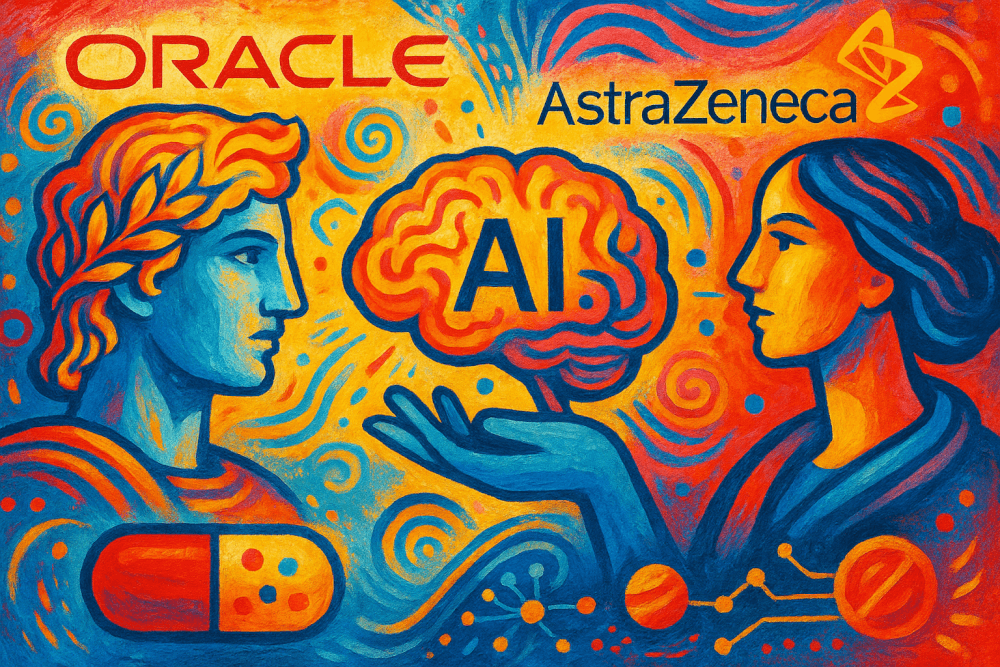
Oracle & AstraZeneca: A New AI Alliance for Drug Discovery
Oracle and AstraZeneca announced a strategic collaboration to apply artificial intelligence, machine learning and cloud-scale data science across the pharma R&D lifecycle. The stated objective is to shorten discovery timelines, improve clinical research efficiency and support more precise patient targeting.
How AI Will Transform R&D
Strategic integration
The partnership centers on Oracle’s cloud infrastructure and data platforms combined with AstraZeneca’s R&D datasets. Expect use cases such as target identification, biomarker discovery, predictive modeling for candidate selection and trial cohort optimization. Large-scale compute and integrated data pipelines will let teams run complex ML workflows and iterate models faster than on traditional on-prem systems.
Impact on patient care
Faster identification of viable drug candidates and improved trial matching can shorten time to market and reduce trial failures. Better biomarker and subgroup models support precision medicine by matching therapies to patients more effectively, and real-world evidence analyses can inform post-approval monitoring and safety profiling.
Industry Implications of This Collaboration
This deal follows a trend of deep tech-pharma alliances that pair proprietary clinical expertise with hyperscale cloud and AI capabilities. Practically, it signals increased investment in data-first R&D: firms that combine clean, interoperable datasets with productionized ML will gain a competitive edge in discovery velocity.
However, technical gains come with governance and regulatory considerations. Model transparency, data privacy, cross-border data flows and reproducibility will require clear frameworks. The collaboration may accelerate momentum for standardized data formats and federated approaches that let partners train models without exposing raw patient data.
For researchers and data scientists, the most immediate outcome will be more accessible compute and integrated toolchains for R&D experiments. For patients, the downstream promise is therapies that reach the clinic more predictably and are tailored to biological subgroups identified by AI-driven analytics.
In sum, the Oracle-AstraZeneca partnership is a practical example of how cloud-native AI can be embedded into pharmaceutical pipelines, with implications for speed, precision and the governance models that will guide future deployments.