
Kevin Monk, Chief Executive Officer and Co-Founder at SARD JV.
Picture a typical NHS trust on a Tuesday morning.
The cardiologists are tracking their annual leave in a shared Excel file. The anaesthetists are using CLWRota for rostering and leave. They have used it for ten years and they know every feature so you couldn’t prise it from their hands. The nurses use the HealthRoster system. Some of the consultants store their leave on SARD alongside their job plans. The ward managers keep theirs in a Word document, emailed round each month. The junior doctors’ rota lives on a whiteboard, photographed on the registrar’s phone. And somewhere in the Doctors’ Mess, laminated to the wall by the kettle, is the on-call rota.
That’s the tip of the iceberg, there are hundreds more rotas, systems, inboxes, spreadsheets and documents containing workforce data. Several of these systems contain a record for Dr Sarah Adebayo, but finding her amongst the mountain of data is a challenge.
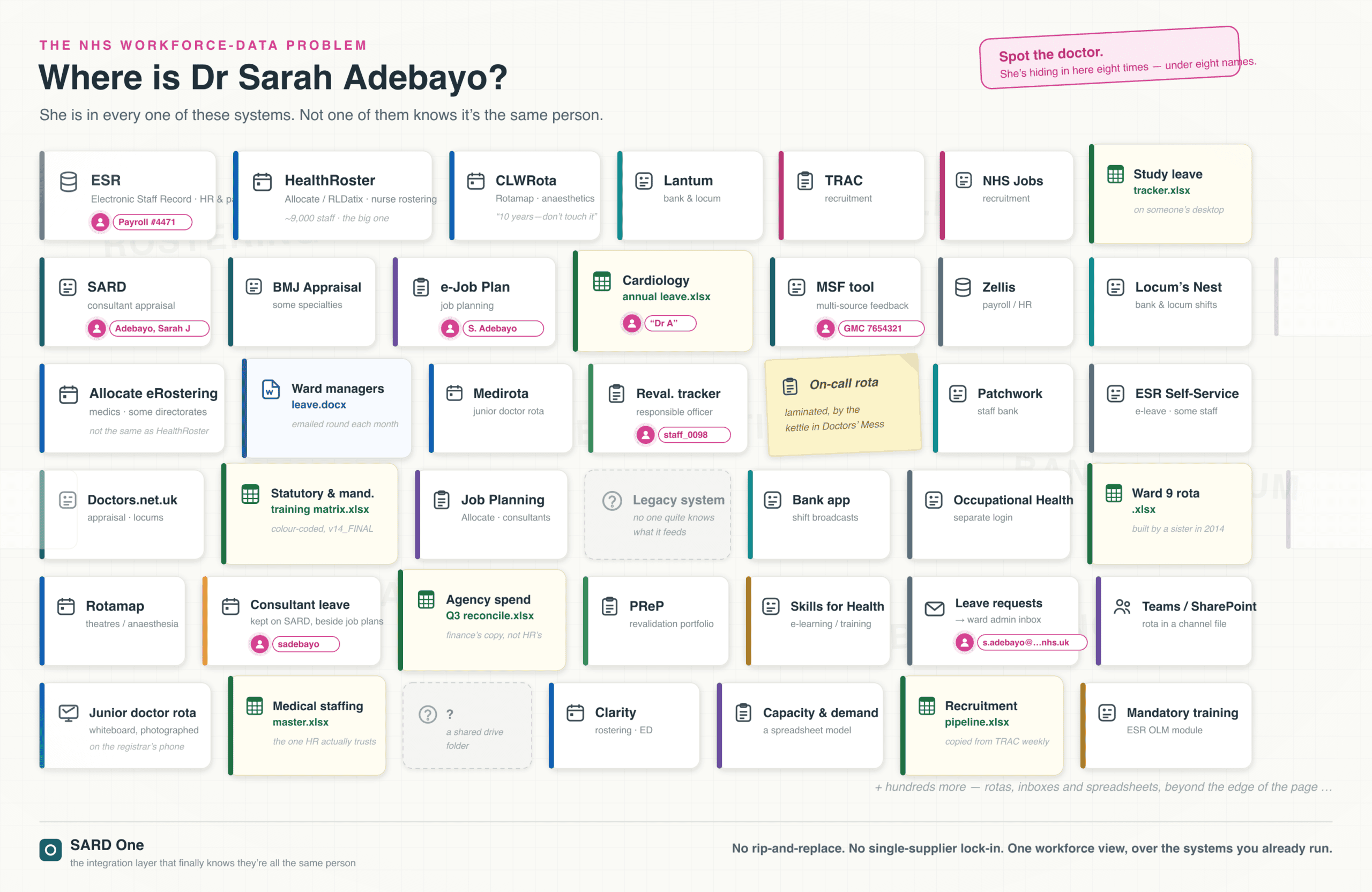
As illustrated below, she appears as Payroll #4471 in ESR, Adebayo, Sarah J in SARD, S. Adebayo in e-Job Plan, “Dr A” in the Cardiology leave spreadsheet, staff_0098 in the revalidation tracker and so on. Yet, none of these systems know it’s the same person.
This isn’t a niche technical problem. It’s the daily reality for the majority of NHS trusts and it has real consequences. There is no single workforce view or cross-system answer to “is this doctor’s job plan capacity matched by their roster?”, “which doctors are due for appraisal this quarter?”, or “what is our mandatory training compliance trended over time?”
Previous integration programmes
Previous attempts to integrate data have fallen foul to high costs, huge implementation undertakings and reliance on immature technology. Increasingly, trusts are moving to unified platforms with a single supplier model. However, this approach creates large procurement exercises, equally high costs and forces trade-offs between good performing systems and mediocre ones because the harsh reality is there is no silver bullet system that does all workforce management functions well.
Trusts don’t want wholesale replacement or another massive transformation programme. What they really need is interoperability and flexibility and now AI and modern integration approaches are stepping in to make it possible to do it faster and at the fraction of cost. It is offering the opportunity to fundamentally rethink how the NHS can manage its greatest asset across a unified platform without these dilemmas.
The best of breed philosophy
We can now create an integration engine enabled by AI and automation that sits over the top of multiple systems and connects them together. Systems can be adopted based on a best of breed model so trusts can retain preferred specialist systems and multiple suppliers can coexist.
The integration layer can provide a framework which can be built on with whatever system is best suited to each workforce management function to create a comprehensive unified workforce view. It avoids a complete rip and replace, losing good functionality, unhappy users and being locked into a single provider. Later down the line, if a system needs to be swapped out with another, it is a straightforward process that can be carried out in days rather than weeks and the overall integration layer is unaffected.
How a best of breed approach can work technically
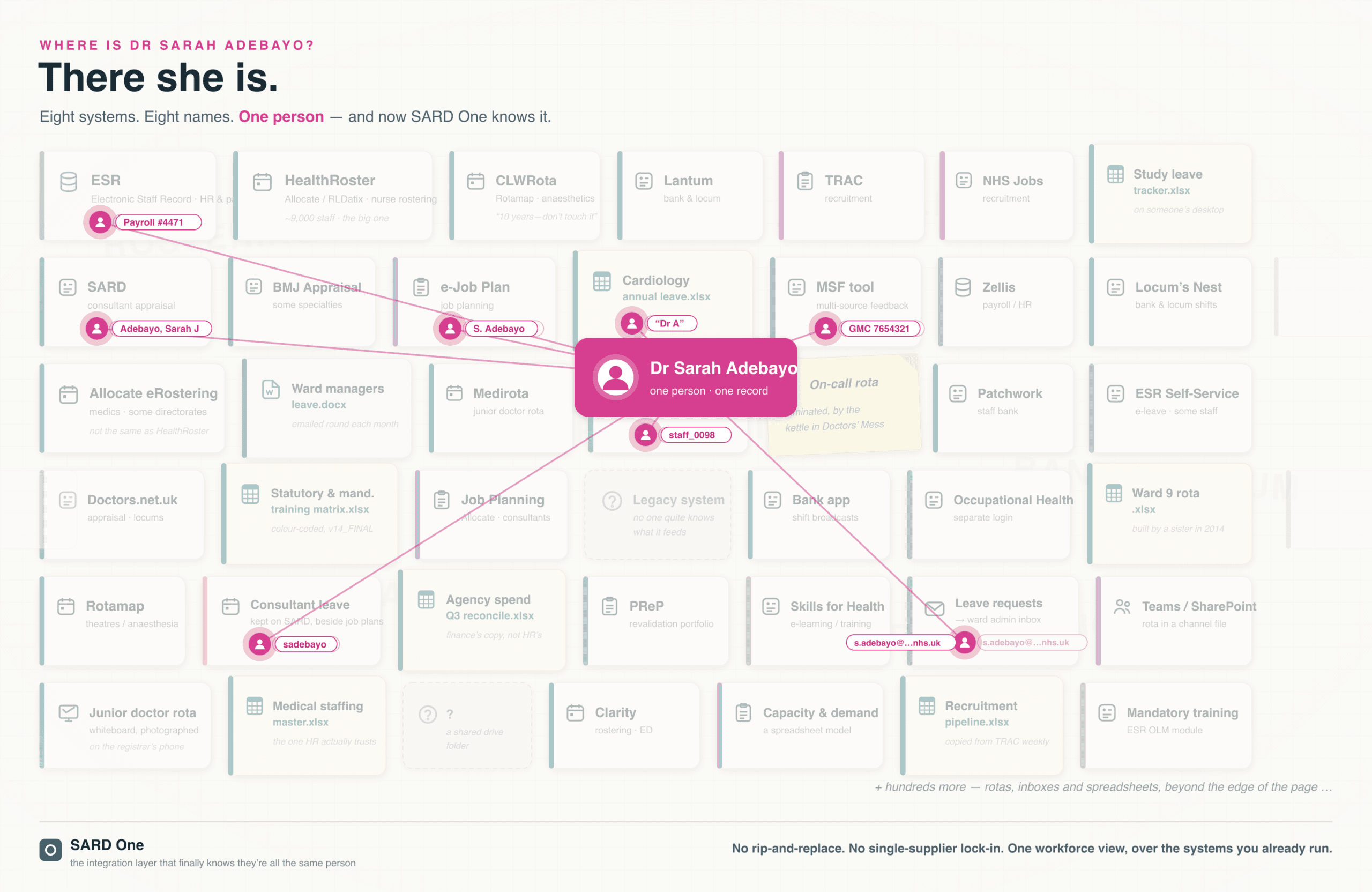
The integration engine can work like a smart directory for all the systems connected to it to create one coherent workforce view and single source of truth. Instead of storing copies of everything in one place, it keeps track of where information lives and how records from different systems are related to each other. So, if we refer back to Dr Adebayo, her unified record would look like this:
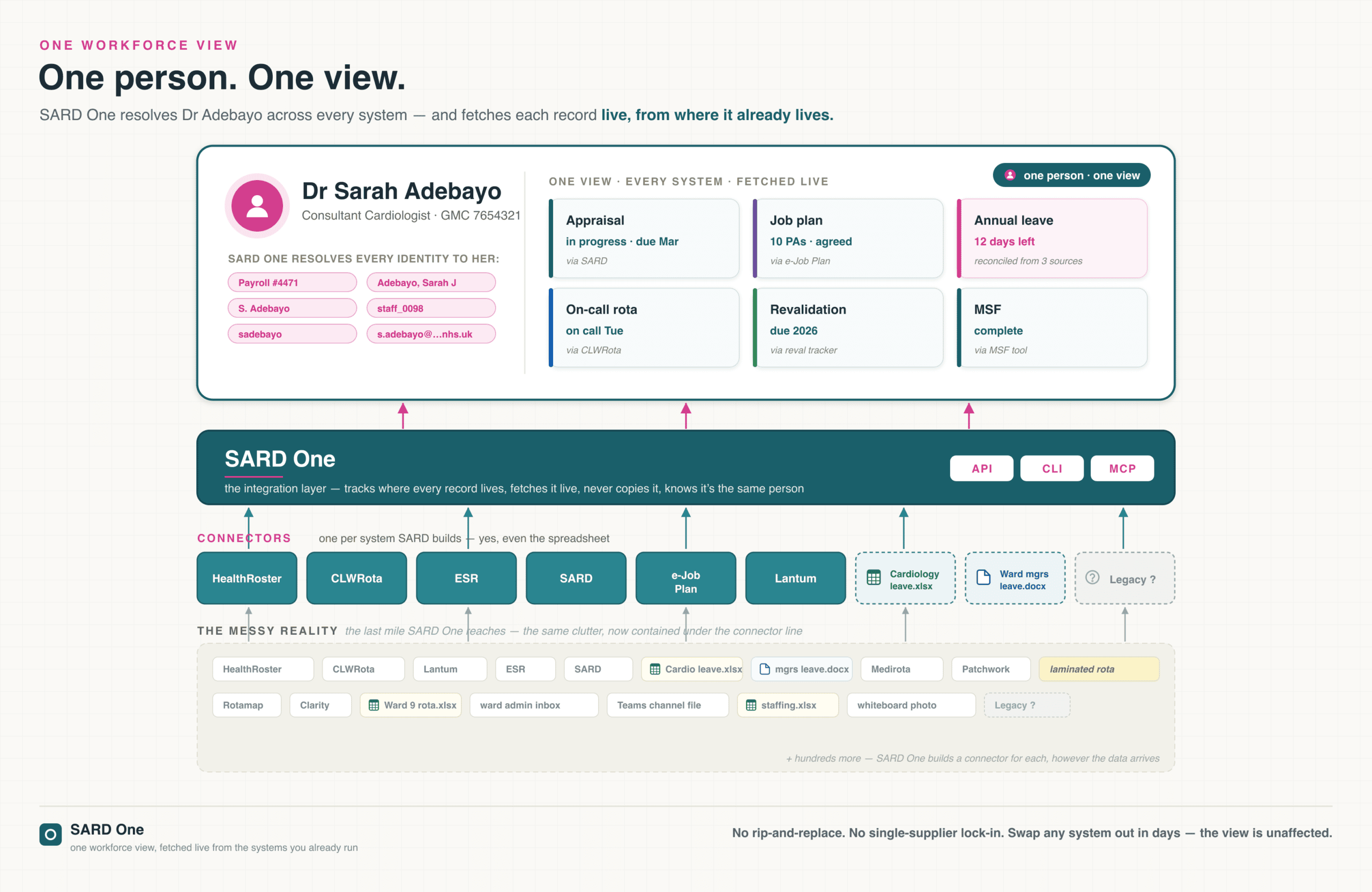
The engine is responsible for keeping a list of connected systems, storing references to information held in those systems, and linking records together so the platform knows that the same doctor exists across multiple applications.
Importantly, the platform does not hold the detailed workforce data. Appraisals, job plans, rotas, leave records and other information remain in the system that owns and manages them. That could be an existing SARD product, a newer SARD application, or a third-party system such as Lantum or Locum’s Nest.
When a user needs information, such as a doctor’s appraisal or rota, the engine retrieves it directly from the relevant system in real time. This avoids duplication, keeps data up-to-date and allows different supplier systems to work together seamlessly.
From a customer perspective, every connected system is treated the same way. The platform does not distinguish between different supplier systems. Each system is simply a connected service that knows how to tell the engine what information it contains, provides summary information for listings and dashboards, returns detailed records when requested and is able to apply its own access and permission rules.
Day-to-day impact
The breakthrough in consolidated data will have a huge impact on Directors of Workforce and HR who require data from multiple systems and spend hours per week, along with their team, reconciling spreadsheets to inform day-to-day workforce decisions. The time saved from having a unified workforce view in one dashboard can be reinvested back into their primary workforce management role. They can aggregate and analyse data from a range of reports such as doctor capacity vs rostered shifts, appraisal compliance trended by speciality, and unfilled shift rates linked to leave patterns.
It streamlines the appraisal and revalidation experience for Medical Directors and Directors of Medical Education, which is mandated by the General Medical Council, complex and critical to maintain high standards of care and patient safety. These professionals find the current process clunky, frustrating and lacking reporting capabilities. All of which often leads to revalidation deadlines being missed. The engine can support appraisers with consolidated information about each appraisee without context-switching across systems and presents a revalidation pipeline, months ahead of deadlines.
For Chief Information Officers, each siloed system demands separate integration work, identity and access controls, and its own reporting. It is a constant integration challenge and a considerable security overhead. An integrated platform with a unified workforce view can be achieved for less than a quarter of the annual budget needed for an alternative SaaS-suite procurement.
Creating the right conditions for transformation
The quest to unify NHS workforce data is heading in the wrong direction because expensive wholesale change won’t address the problem and will create more issues longer term. The real issue is unlocking the valuable workforce data that exists in current systems, bringing it together and being able to interpret it meaningfully, with minimal disruption and cost. This collaborative ecosystem will initiate a serious paradigm shift for NHS workforce management and enable transformation to flourish. Only then will we be able to find Dr Adebayo at the click of a button.